Built for every stage of the OKR cycle.
From planning objectives to scoring results — OKR Studio covers each step so your team stays aligned across quarters.
AI Writing Assistant
Type a short description of what you want to achieve. The AI assistant instantly generates a clear objective with 3-5 measurable key results, all formatted to best practices.
Smart Validation
A live quality score grades each key result as you type: is it measurable, does it have a baseline, does the target move, and does it describe an outcome rather than a task? The score uses fixed rules, so it works on every plan. With AI consent, Check with AI adds AI-assisted rewrites you can apply in one click. Get instant feedback before you commit to a goal.
Read the guideOKR Cycles
Run quarterly, monthly, or custom-length cycles. Each cycle moves through planning, tracking, and evaluation so nothing falls through the cracks.
Team Alignment
See how objectives connect across teams. Alignment views show dependencies and shared goals, making cross-team coordination visible.
Progress Tracking
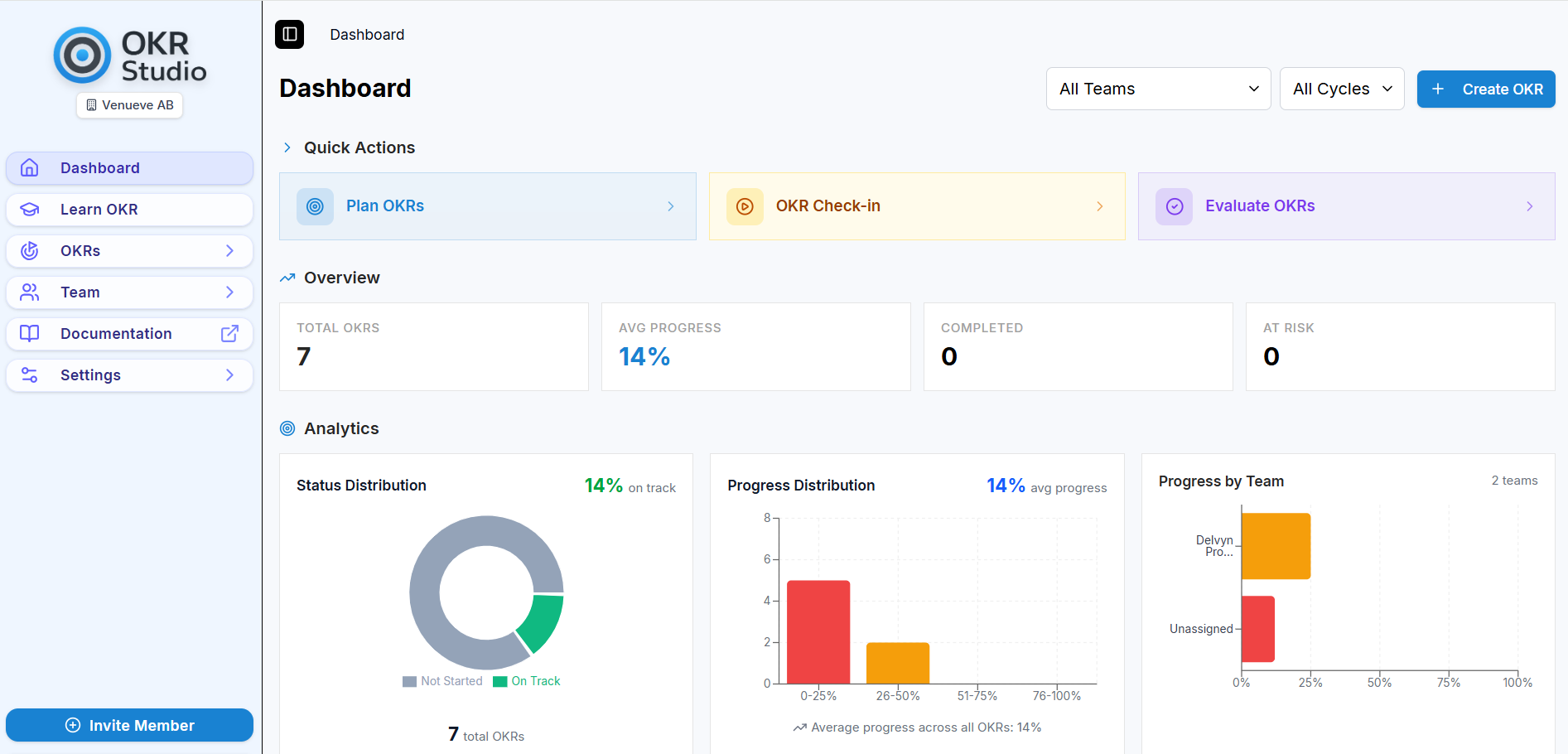
Drag a slider to update progress. Add a quick note. Done. No complex forms, no mandatory fields. As simple as Google Sheets.
Structured Check-Ins
Replace status meetings with asynchronous check-ins. Team members update key result scores, add context, and flag blockers — all in one place.
Cycle Evaluation
Close each cycle with scored objectives and structured retrospectives. Capture what worked, what didn't, and carry those insights into your next quarter.
Integrations
Connect to Linear, Jira, Confluence, and Azure DevOps. Link key results to issues, tickets, and work items in the tools you already use.
Analytics & Insights
Surface drift before week 6: progress tracking, cycle-pace and completion trends, team alignment dashboards, confidence scoring, and historical cycle comparisons that show where a key result is falling behind.
The OKR MCP That Reads Your Cycle
Connect Claude Desktop, ChatGPT, GitHub Copilot, Cursor, Glean, or any MCP-compatible assistant to your OKR data — wired into the same cycle-aware analysis that powers at-risk alerts and Slack summaries, not just a raw data feed. Running the finalized 2026-07-28 MCP spec, stateless by default. Ask plain-language questions about progress, blockers, and alignment. Most teams connected in under 10 minutes.
Slack Integration
Submit check-ins, view progress summaries, and get at-risk alerts directly in Slack. Five slash commands cover your entire OKR workflow without leaving your team's conversation.
Objective Grading
Score every key result on a 0–1.0 scale with automatic red/amber/green status. Each objective rolls up to a 1–5 rating with team-alignment assessment and lessons captured for the next quarter — turning end-of-cycle reviews into a repeatable, data-driven process.
Built for Retention
Most OKR programs fail in cycle two. OKR Studio builds the habit: structured check-ins keep momentum through the week-6 cliff, alignment dashboards surface drift before it’s too late, and automated evaluations close the loop so insights carry forward.
Read the guideMid-cycle Readout
A key result at 30% is fine in week 2 and failing in week 11 — flat thresholds and generic health scores can’t tell the difference. At the exact midpoint of every cycle, OKR Studio turns cycle-position-aware pace data into one readout: how many objectives are on pace, which team owns the behind-pace key results, and a suggested refocus — in the app, and delivered once to Slack. Optionally, an AI-assisted read adds two or three sentences of interpretation on top — the numbers stay calculated by OKR Studio, never by the model. A 15-minute refocus conversation instead of a list of flagged KRs.
Strategy: Vision, Strategies and Products
Give your OKRs a direction. An optional Strategy section lets you write your vision and the strategies that serve it, right next to your objectives — and group them under products if you run more than one. Pick a strategy as context when drafting OKRs with AI, so new objectives follow from it and are linked to it when you create them. Off by default: an Admin turns it on in Settings, and turning it off hides it without deleting anything.
Read the guidePaused on Purpose
Dropping a key result mid-cycle is often the right call. Mark it Paused, add a reason if you like, and OKR Studio stops counting it: objective progress, pace, the mid-cycle readout, Slack at-risk alerts and your MCP assistant all treat it as a deliberate choice, not a key result falling behind. Resume it any time.
Read the guideThe AI that drafts your goals isn’t the AI that saves them.
Most OKR tools race to write goals for you. But a goal written in ten seconds still fails in week six if nothing watches it. OKR Studio is built around the analysis layer — validating key results before the cycle starts, then reading progress against cycle pace to catch drift while there’s still time to act.
Teams that analyze, not just draft, miss far less.
Teams using AI for both analysis and writing accept a missed goal 14% of the time — versus 35% for teams that only use AI to draft (source: OKRs Tool). Catching drift beats generating goals.
You keep the pen. The AI keeps watch.
Drafting and validation speed up planning. Cycle-aware check-in summaries and at-risk signals do the harder job — telling you which key results are slipping while you can still change the outcome.
Ready to run your first cycle?
Start your 14-day free trial and create your first objectives today.
Start free trial